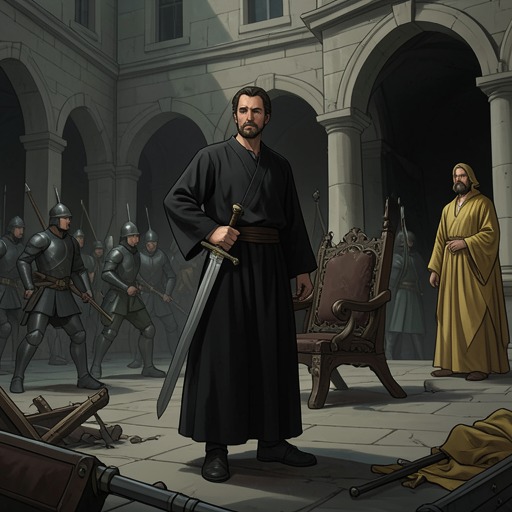
Xutian hunting incident
The Romance of the Three KingdomsThe Xutian hunting incident is a staged imperial hunt in which Cao Cao publicly occupies the emperor’s place without formally taking the throne. By taking the imperial bow and accepting the courtiers’ praise after shooting a stag, he makes his command over the court visible; Xuande prevents Guan Yu from turning that provocation into an armed confrontation. The episode condenses a struggle over sovereignty into a carefully arranged public ceremony.
Background and Political Setting
The hunt follows Cao Cao’s return to the capital, where the emperor has welcomed him ceremonially. Xuande, recognized as a member of the imperial lineage, has been named imperial uncle and taken into the emperor’s confidence. Meanwhile, Cao Cao has grown increasingly arrogant, destroying the careers of those who displease him. When Cheng Yu suggests that he take the throne, Cao Cao judges that loyal ministers would resist such an open move. Instead, he proposes a subtler course: encroaching on imperial powers until opposition can no longer stop him.
The emperor does not want to go hunting, but finds it increasingly difficult to refuse Cao Cao. Cao Cao plans the entire event and supplies its personnel, even though court officials accompany the emperor. The arrangement already shifts practical authority away from the sovereign: the emperor goes to the hunt, but its organization and security belong to Cao Cao.
The Hunt and the Stag
The emperor carries the imperial jewelled bow and gold-tipped arrows, and the three brothers-in-arms accompany him as bodyguards. Yet the positioning of the party reverses the expected hierarchy. Cao Cao rides beside the emperor, his own men form up behind them, and the courtiers and ministers are pushed to the rear.
When a stag breaks cover, the emperor shoots three times and misses. He then invites Cao Cao to try. Cao Cao takes the imperial bow and arrows and kills the animal with a single shot. Because the arrow is the emperor’s, those watching assume the emperor made the kill. They press forward, applauding and calling for the emperor to live ten thousand years.
Cao Cao, not the emperor, acknowledges their praise. The courtiers understand the breach: the acclaim belongs to the sovereign, yet Cao Cao receives it without correction. Their visible alarm makes the moment a public demonstration of how completely his presence has unsettled the court’s established order.
Xuande, Guan Yu, and Restraint
Guan Yu reacts with fury. He urges his horse forward and draws his sword, intending to kill Cao Cao. Xuande catches his eye and signals him to stop. Guan Yu obeys his elder brother, reins in, and returns his sword to its sheath. His restraint is not approval: it is a decision to prevent an immediate clash with Cao Cao’s followers.
Xuande then faces Cao Cao and congratulates him on the shot. Cao Cao laughs and attributes his success to the emperor’s blessing, before riding over to offer the emperor his congratulations. But he does not give back the imperial bow. He hangs it over his own shoulder, leaving the ceremonial object—and the authority it represents—in his possession. His deferential explanation and his appropriation of the bow pull in opposite directions: the spoken gesture acknowledges the sovereign, while the visible action claims the sovereign’s prerogative.
Consequences and Narrative Significance
After the party returns to court, Guan Yu demands to know why Xuande stopped him. Xuande explains that an attack would have exposed both the emperor and Guan Yu to the violence Cao Cao’s followers would unleash. The incident therefore ends without an open challenge, but not without consequence: the danger of confronting Cao Cao is made explicit, and resistance is shown as requiring discipline and concealment rather than a direct blow.
The hunt’s political force lies in its ceremonial form. Cao Cao need not announce that he is emperor; the placement of the participants, the use of the imperial weapon, the misdirected acclamation, and his retention of the bow let the court witness authority changing hands in practice. In the novel’s account of the Han dynasty’s collapse, the scene makes the gap between imperial title and effective power visible through a single public ritual.